VELO-PERSO TECHNICAL GUIDE · SHIMANO 105 DI2 R7100 / R7150 · UPDATED NOVEMBER 2026
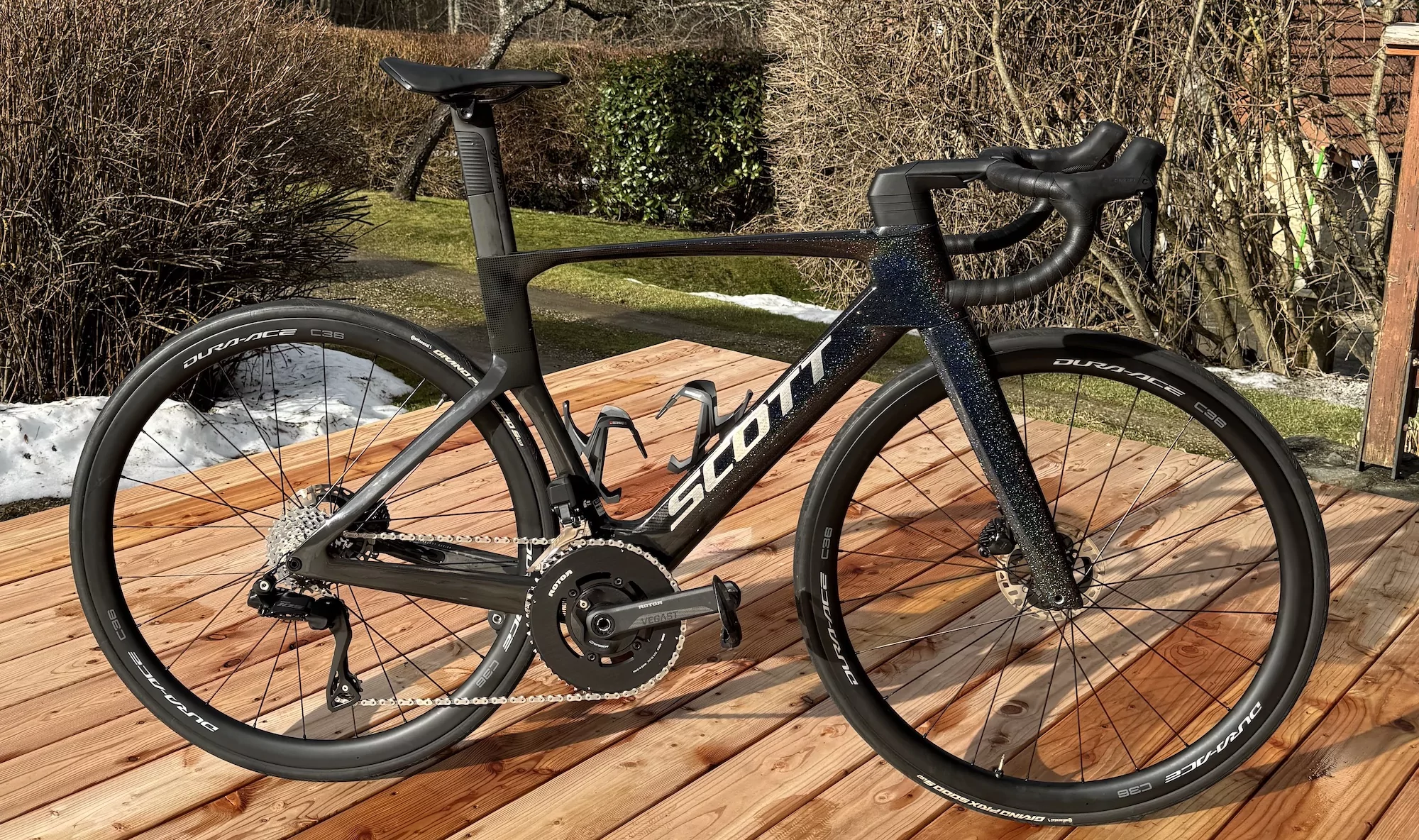
Your Shimano 105 Di2 deserves better than an 8 kg-plus bike.
A great frame and a reliable electronic groupset, often paired with components selected to meet a price point. Rather than buying a whole Dura-Ace groupset, the aim is to create a bike that is lighter, better geared and more enjoyable to ride.
With carefully chosen cranksets and components, getting below 8 kg is realistic for many builds already close to the threshold — but only an accurate bike-by-bike weigh-in can confirm it.
DEFINE THE PRIORITY FIRST
Four ways to improve a Shimano 105 Di2 road bike
Not every upgrade achieves the same thing. Decide what you want to change before spending money on a component.
Train with power
Use power data to pace efforts and build structured training. A power meter is not a weight-saving upgrade.
Go bigger
Move beyond typical stock 105 chainrings to 54/40 or 56/40 for faster riding.
Lose unnecessary grams
A complete crankset is often one of the most useful places to save weight on a stock 105 bike.
Refine the drivetrain
Bottom bracket, chain, pulleys, cage and hub bearings: mechanical refinement and riding enjoyment.
| Your objective | Where to start | What changes |
|---|---|---|
| Move closer to 8 kg | QO RACE Light / ROTOR ALDHU Carbon | Roughly 150–230 g may be saved against some stock 105 cranksets, depending on the configurations compared |
| Improve training | INPEAK left arm, TWiN2 or a meter on a lighter crankset | Actionable power data, not lower bike weight |
| Choose larger gearing | ALUGEAR AERO 54/40 or 56/40; QO 54/40 | More suitable gearing for fast racing |
| Refine the drivetrain | Bearings, pulleys, cage and correctly maintained chain | More satisfying operation; actual watt savings vary |
AXIS 03 · WEIGHT · THE MAIN COMPONENT CHANGE
The crankset is often the best place to start saving weight
Many Shimano 105 Di2 bikes use frames closely related to their more expensive Ultegra or Dura-Ace equivalents. The frame may already be competitive; drivetrain and finishing components contribute much of the extra mass. The stock Shimano 105 R7100 crankset is worth examining.
Using 765 g as an indicative complete Shimano 105 crankset weight, a QO RACE Light weighed by Velo-Perso at 571 g is around 194 g lighter; the 538 g ROTOR ALDHU Carbon Direct Mount would be around 227 g lighter. These are indicative comparisons, not matched laboratory tests with identical arm lengths and rings.
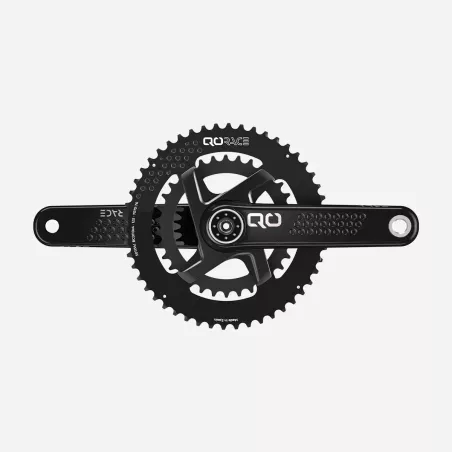
QO RACE Light: carbon and low weight
571 g measured in 165 mm / 50-34. Carbon arms, 28.99 mm DUB-diameter spindle, and 50/34, 52/36 or 54/40 chainrings. A striking lightweight option with an integrated finish.
Explore QO RACE Light →
ROTOR ALDHU Carbon Direct Mount
538 g measured in 170 mm / 48-31 Q-Rings; 50/34 and 52/36 also available. Carbon arms, 30 mm spindle, direct-mount Spidering. Particularly appealing for climbing and hilly rides.
Explore ALDHU Carbon DM →
ROTOR ALDHU Carbon Spider Mount 12s
The modular carbon ROTOR alternative, offering additional chainring choices including racing-oriented configurations. Compare the total mass of your exact arms, spider and chainrings.
Configure ALDHU Carbon 12s →
ROTOR VEGAST: sensible 30 mm value
For a more limited budget, a 30 mm VEGAST can be a smart alternative to the equivalent 24 mm configuration. It is not carbon, but it offers a strong balance of cost, weight and drivetrain options.
Compare VEGAST 24 and 30 mm →AXIS 02 · GEARING
Are your stock Shimano 105 chainrings too small?
Shimano 105 bikes commonly come with 50/34 or 52/36 chainrings. Fast group riders and racers may prefer 54/40 or even 56/40 to match their cadence at high speeds. You do not need a completely new groupset to achieve this.
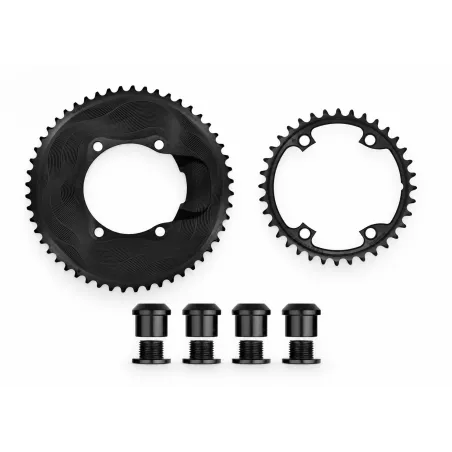
ALUGEAR AERO without cover
Two AERO chainrings and mounting hardware, with no cover. 48/34, 50/34, 52/36, 54/40 and 56/40 depending on stock. Designed to retain your FC-R7100 crank arms.
Choose the no-cover kit →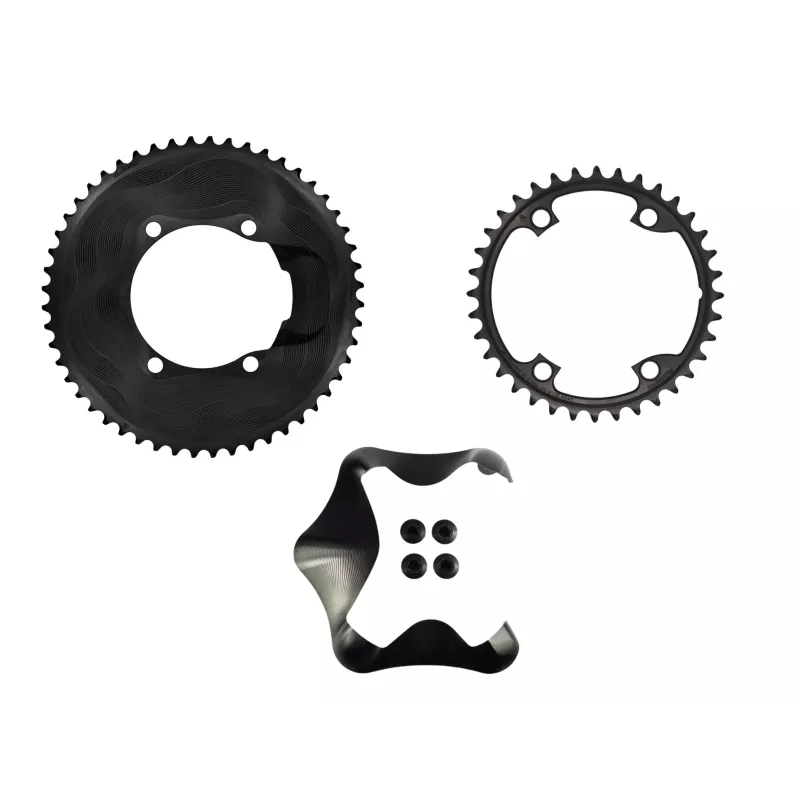
ALUGEAR AERO with cover
Adds a more integrated outer face and premium appearance. Similar expanded gearing options, with a model-specific cover that must match your exact Shimano crankset.
Explore the kit with cover →| Chainrings | Typical use | Our view |
|---|---|---|
| 50/34 | Climbing and all-round riding | Excellent low gearing when paired with a suitable cassette |
| 52/36 | Sportives and rolling terrain | A sensible all-round fast road option |
| 54/40 | Fast bunch riding and racing | Worth looking at from QO, ALUGEAR and selected ROTOR builds |
| 56/40 | Specialised high-speed use | Check front derailleur positioning and frame clearance |
Larger rings do not create more power: they change the speed/cadence relationship. Verify front derailleur height, frame clearance, chain length and the shifting capacity of the exact setup. Not every frame accommodates every ring combination.

Another option: ROTOR NOQ round chainrings
We retain this alternative for riders who want conventional round rings. Check the available sizes and compatibility with your exact Shimano 12s crankset.
AXIS 01 · BETTER TRAINING
A power meter improves your training, not the bike’s weight.
Power is a powerful tool for pacing, structured intervals and long-distance events. But INPEAK does not solve the weight issue of a stock Shimano 105 bike. Keep that goal separate from choosing a light carbon crankset.
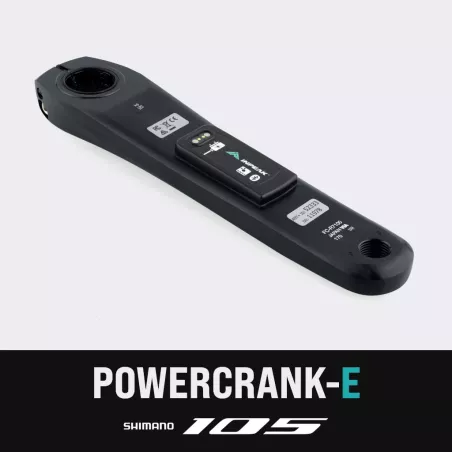
INPEAK POWERCRANK-E · 105 left crank arm
The straightforward upgrade that retains FC-R7100: €269* for a rechargeable Shimano left crank arm with integrated sensor. Left-side measurement estimates total power. Match arm length and frame clearance.
View the left crank power meter →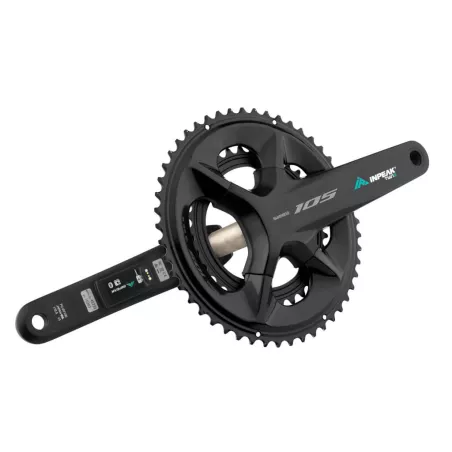
INPEAK TWiN2 105 · independent L/R power
Measures both legs independently using a complete Shimano 105 crankset. €599* on the checked product listing. An excellent training decision, not a weight-saving purchase.
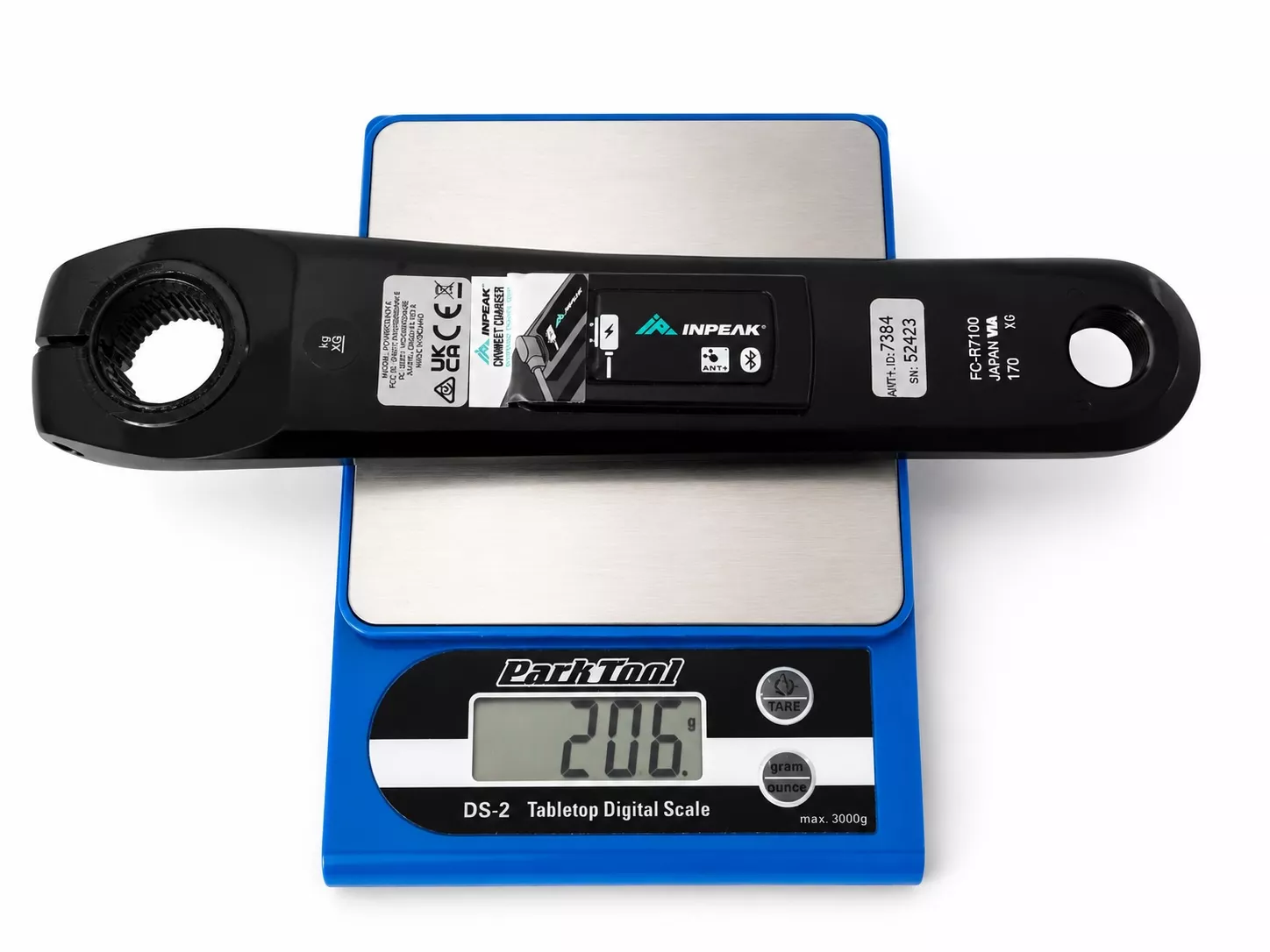
View TWiN2 →Velo-Perso weighed an INPEAK 105 R7100 170 mm left crank arm at 206 g. This is an individual arm measurement, not the weight of a complete crankset.
Choose the crankset family first. The ROTOR ALDHU Carbon INspider V2 combines carbon arms with power measurement. Power-meter pedals are another option to pair with a lightweight QO RACE crankset. Note that spider-based power measurement is not necessarily independent left/right measurement.
AXIS 04 · MARGINAL GAINS
Bottom bracket, pulleys, cage, chain and wheel bearings: refine the ride
These parts can improve the quality of operation, maintenance and some sources of friction. Their actual benefit depends on setup, lubrication and component condition. They come after the crankset when reducing total bike weight is the main goal.
1. Bottom brackets: identify the frame and spindle first
Shimano 105 R7100 uses a 24 mm spindle, but the frame may use BB86, BSA, T47 or another standard. ROTOR 30 mm cranksets need a matching 30 mm bottom bracket. QO RACE uses 28.99 mm / DUB diameter, which is not the same as a 30 mm spindle. The pictured Scott’s BB86 shell does not mean every 105 Di2 bike is BB86.

Bikone BB86 steel 41/24
A practical, dependable choice for retaining Shimano 105 cranks on a compatible BB86 frame. Ceramic bearings are not mandatory.
View BB86 24 mm →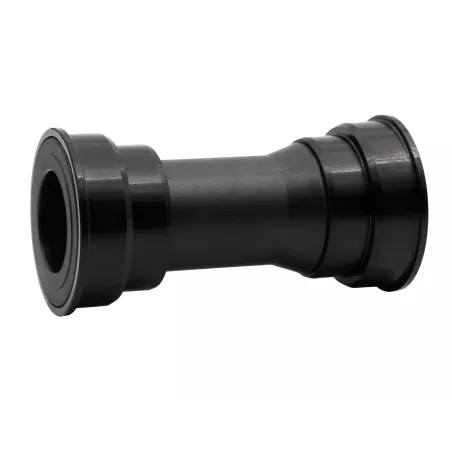
CyclingCeramic BB86 ceramic 41/24
A premium-bearing option that retains the 24 mm Shimano crankset, only when the frame shell matches the specified standard.
View ceramic BB86 →For a 30 mm ROTOR crankset in a BB86 frame: Bikone BB86 41/30 steel or CyclingCeramic BB86 41/30. For a threaded Shimano setup, see Bikone BSA 24 mm. QO requires a frame-matched 29 mm/DUB bottom bracket, not a 41/30 item. Use our bottom-bracket finder.
2. CyclingCeramic pulleys and cages:


Shimano 12s ceramic pulley wheels
A discreet change: retain the original cage and fit compatible pulley wheels. Check compatibility with the exact RD-R7150 derailleur.
View pulley wheels →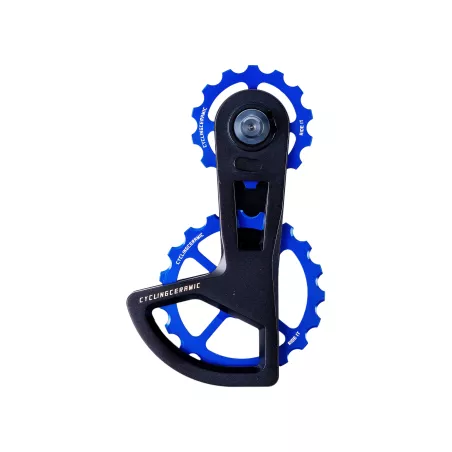
CyclingCeramic Race · 105 Di2
Current oversized cage with 14/19-tooth pulleys and ceramic bearings, offering a distinctive finish.
View Race cage →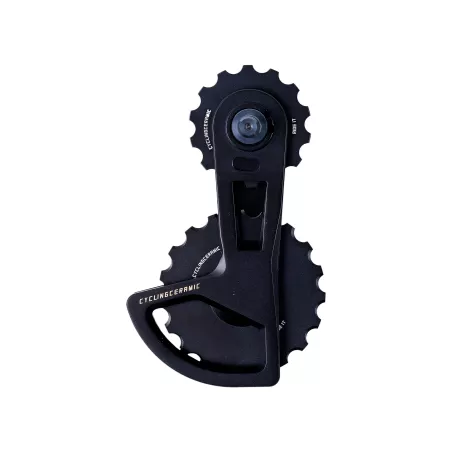
CyclingCeramic Pro · 105 Di2
14/19-tooth solid-profile pulleys with carbon/aluminium cage. A more integrated aero-oriented finish, subject to derailleur and cassette compatibility.
View Pro cage →3. Chain: maintenance matters more than claims
A clean Shimano 12s-compatible chain, properly maintained and lubricated, is one of the most rational first steps. For a specific race objective, a CyclingCeramic low-friction racing chain can provide a finishing touch, but its treatment does not remove the need for normal care after the first few hundred kilometres.
4. Wheel bearings: the finishing touch, not the starting point
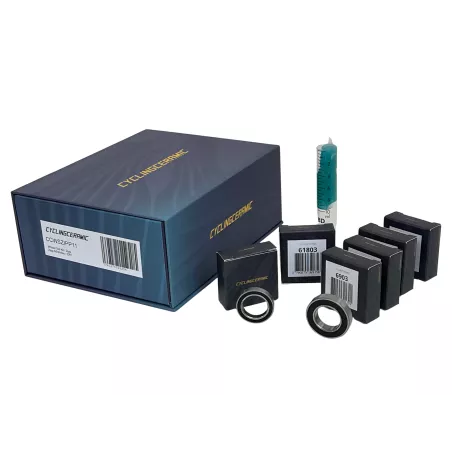
We offer solutions for Zipp, DT Swiss, Mavic, Roval, Vision and others. The correct kit depends on the exact hub model and bearing dimensions, not the wheel’s brand alone. Any friction saving is generally modest; it should not be confused with the large mass differences possible between cranksets.
THE VELO-PERSO VIEW
Our purchasing order for a stock Shimano 105 Di2 road bike
FAQ
Frequently asked questions: Shimano 105 Di2 weight, gearing and efficiency
Can a Shimano 105 Di2 road bike weigh less than 8 kg?
Yes, if the starting weight and other components allow it. On a bike already close to 8 kg, a lighter carbon crankset and a few finishing parts can make the difference. Weigh the bike consistently; this result is not guaranteed for every model.
Which component should I replace first to save weight?
A complete crankset is often a sensible starting point. Velo-Perso weighed a QO RACE Light at 571 g in 165 mm and 50/34, and a ROTOR ALDHU Carbon Direct Mount at 538 g in 170 mm and 48/31. Compare weights only with the measurement configurations in mind.
Is a 30 mm crank spindle always lighter than Shimano 24 mm?
Not always, but some comparable 30 mm or DUB versions can save about 50 to 80 g. The difference largely depends on spindle architecture and does not guarantee better stiffness or drivetrain efficiency. Mass near the axle has relatively little effect on rotational inertia.
Does QO RACE Light use a 30 mm bottom bracket?
No. Its spindle is 28.99 mm, with SRAM DUB diameter. Select a DUB bottom bracket compatible with the exact frame shell and width. Do not substitute a 30 mm bottom bracket.
Does the INPEAK Shimano 105 left power-meter crank save weight?
No. It adds power measurement while retaining the original Shimano 105 crankset. It measures left-side force and estimates total power. To reduce bike weight, consider changing the crankset instead.
Can I use 54/40 or 56/40 chainrings with Shimano 105 Di2?
Some ALUGEAR 12-speed kits provide those sizes while retaining the Shimano 105 FC-R7100 arms. Verify front derailleur positioning, outer ring clearance, chain length and frame-specific limitations.
Must I change the bottom bracket when switching to ROTOR or QO?
Changing from a 24 mm Shimano spindle to a ROTOR 30 mm or QO 28.99 mm spindle generally requires a different bottom bracket that fits both the frame and the crankset. Not all Shimano 105 Di2 bikes use BB86.
Are ceramic pulleys, cages, chains and wheel bearings a priority?
They can improve mechanical refinement and riding enjoyment, but any gain depends on installation, maintenance and conditions. If weight is your main goal, start by examining the crankset.
Which CyclingCeramic cages are current for Shimano 105 Di2?
The current choices are the compatible CyclingCeramic Race and Pro cages for Shimano 105 R7100/R7150 rear derailleurs. The older 14/19 OSPW cage has been superseded; always check the product listing and cassette compatibility.
* Prices checked on 1 November 2026 and subject to change. The product page and current stock take precedence. Weight figures apply only to the stated configurations; weight or friction savings are not guaranteed. Confirm frame and crankset compatibility before ordering.