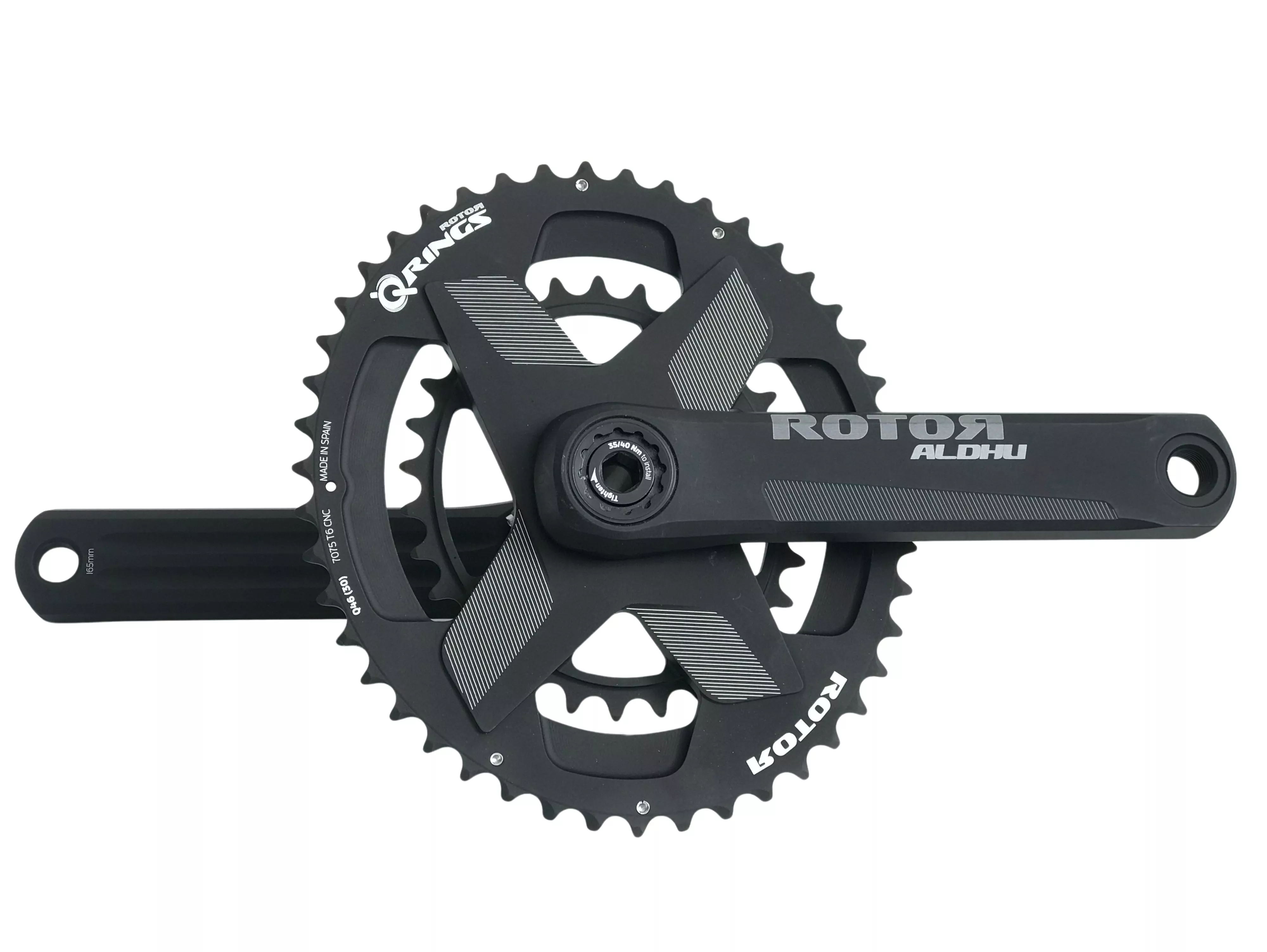
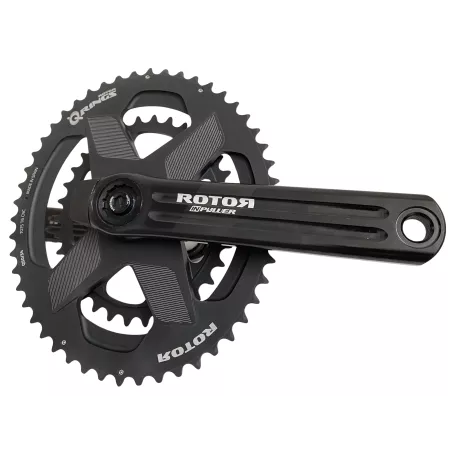
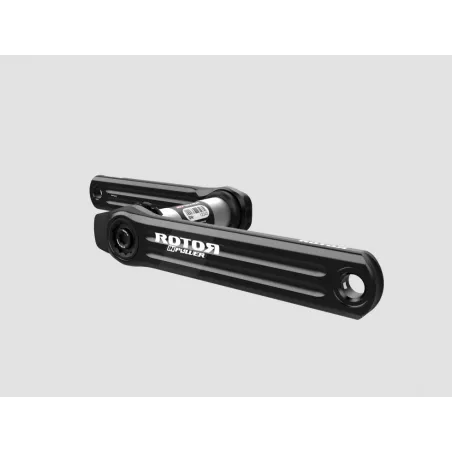
Rotor Aldhu crankset with 165mm arms
165mm Rotor crank arm. Rotor is a specialist of 165mm cranksets and this length is available for 100% of the manufactured cranks. With the modular system, Vegast and Aldhu are one of the cheapest solutions if you need a 165mm crankset

WHY CHOOSE 165 MM CRANKSETS?

165 mm crank arms improve cadence, reduce knee stress, optimize aerodynamics, and provide greater safety on technical terrain. They are particularly suited for riders between 1m65 and 1m80, especially when paired with well-spaced 12-speed gearing. Their growing use in road racing, triathlon, gravel, and track sprinting confirms their versatility.

Riding with 165 mm crank arms makes it easier to maintain a high cadence and smooth pedalling. The reduced range of motion lessens muscle fatigue and protects the joints, while improving aerodynamic positioning.

KEY BENEFITS
  • Increased cadence: ≈ +1 rpm per mm shorter crank length.
  • Reduced fatigue: greater comfort on long rides.
  • More aero position: smaller torso–thigh angle, ideal for TT/triathlon.
  • Weight savings: 1 to 3 g saved per mm less crank length.
  • Safety: better ground clearance in corners and technical terrain.
165 mm: benefits by discipline
Discipline Benefit
Climber Higher cadence on climbs, delays fatigue on steep ascents and sportives.
Time trialist Very useful at threshold on flat; effective for ~10 km solo efforts (cadence + aero). Less obvious otherwise.
Sprinter Track cycling standard; boosts cadence in the final 100 m.
Triathlon Widely used; enables a more aero and efficient position. Sometimes even shorter than 165 mm.
Gravel Helps tackle steep ramps at high cadence, especially with modern wide-range gearing.
Recommendations by rider height
Height Recommendation
1m65 – 1m75 Ideal range for 165 mm crank arms.
1m75 – 1m80 May benefit from higher cadence, depending on discipline and goals. (e.g., Pogacar: 1m76.)
> 1m80 Less common; reserved for specific cadence/aero goals. Inseam length is the main factor.
Why our customers choose 165 mm (Velo-Perso.com data)
Reason % of purchases
New bike: no suitable crank length option available 30 %
Trend/fashion 25 %
Aerodynamics (often triathletes) 20 %
Bike fit study 15 %
Previously tested and wanted on current bike 5 %
Injury-related 5 %
IMPORTANT TIP

Avoid switching directly from 175 mm to 165 mm. Reduce in steps of 2.5 to 5 mm. Rotor modular cranksets let you easily test multiple lengths (from ~$120 per crank arm pair).

VELO-PERSO.COM'S OPINION

The rise of 12-speed gearing makes 165 mm crank arms highly relevant: they require smaller, well-spaced gear ratios to remain comfortable and efficient. On older 8-speed bikes, it's more challenging due to less flexible gearing. 165 mm generally increases average cadence, so adjust your gearing accordingly.

165 MM CRANKSETS: VELO-PERSO EXPERTISE

Switching to 165 mm cranks isn't just about size; it's a biomechanical optimization. By reducing the pedaling circle, you open up the hip angle and optimize your torque. Contrary to popular belief, power does not drop: it becomes more sustainable thanks to increased cadence.

Bike Fit Adjustments: Switching from 170 to 165 mm
Adjustment Recommended Change The Benefit
Saddle Height +5 mm (theoretical) Compensates for the higher position at Bottom Dead Center. Note: 2 to 3 mm is often enough.
Handlebar Height +5 mm (keep the same drop) Maintains your aero balance after raising the saddle.
Knee Strain Immediate Relief The smaller circle limits extreme knee flexion at Top Dead Center (TDC).
PEDALING SCIENCE: TORQUE VS CADENCE

Our analysis via Rotor software proves that low cadence drastically reduces torque during dead spots. With 165 mm cranks, the slight loss of leverage is fully compensated by higher cadence. Since Power = Torque x Cadence, your total output is preserved while reducing muscular fatigue.

Morphology: Height vs Inseam
Profile Velo-Perso Recommendation
Up to 1m80 (5'11") Suitable for all. The new standard for optimizing efficiency.
Inseam < 90 cm Primary Target. Immediate gain in comfort and leg speed.
Inseam > 90 cm Caution. We suggest 170 mm or 172.5 mm to respect your natural leverage.
THE STOCK BIKE PROBLEM

Most bikes are delivered with cranks that are too long. Replacing an entire groupset is costly and frustrating.

  • Rotor Modularity: Change crank length without replacing the whole crankset.
  • Micro-Compact (48/31): Perfect for 165 mm to maintain high cadence on steep climbs.
  • Weight Savings: Our Aldhu Carbon solutions are significantly lighter than stock OEM parts.

EXPERT VERDICT

"Switching to 165 mm is the most underrated modification to improve endurance. With 12-speed groupsets and proper gearing, you won't 'spin out': you smooth out your effort. It's the end of joint tension peaks and the beginning of a more fluid, sustainable stroke."

— Team Velo-Perso.com

-€140.01
Best seller !
Rotor Aldhu

Rotor Aldhu 12S 24 or 30mm crankset

€550.00 €409.99
-€161.01
Best seller !
Aldhu Carbon

Rotor Aldhu Carbon 12s Crankset Shimano & Sram

€746.00 €584.99
-€266.00
Best seller !
Rotor Vegast

Rotor Vegast Inspider V2 2x12s

€965.00 €699.00
-€365.10
Best seller !
Aldhu Carbon

Rotor Aldhu Carbon Inspider V2

€1,265.00 €899.90
-10%
INpower

Rotor Inpower V3 DirectMount crankset/powermeter 165/170/172,5/175mm

€469.99 €422.99
-€150.00
Our 2026 powermeters

Rotor 2INpower SL powermeter crankset 12S

€999.00 €849.00

FAQ – 165 mm Cranksets & Expertise

Should I adjust my saddle height when switching to 165 mm?
Yes. When switching from 170 to 165 mm, you should theoretically raise your saddle by 5 mm to maintain the same leg extension at Bottom Dead Center. Velo-Perso Pro Tip: Often, 2 to 3 mm is enough. Also, consider raising your handlebars to maintain your initial aero drop.
Do I lose power with a shorter crank arm?
No. The slight loss in leverage is compensated by an increase in cadence. Our Rotor software analysis shows that higher velocity smooths out torque. Since Power = Torque x Cadence, your total output remains identical but becomes more sustainable.
How to check compatibility with my frame?
Ensure your bottom bracket matches your crankset's axle diameter and length. At Velo-Perso, we offer brackets compatible with all Shimano, SRAM, and Rotor standards (BB86, BSA, Pressfit, etc.).
Can I switch back to 170 mm later?
Yes. With a modular Rotor crankset (Vegast, Aldhu), you only need to replace the crank arms. With standard Shimano or SRAM sets, you would need to replace the entire unit.
Is 165 mm suitable for my height (up to 1m80)?
Absolutely. Up to 1m80, 165 mm is widely used. However, inseam is the key factor. For an inseam over 90 cm, we generally recommend 170 mm or 172.5 mm to respect your natural leverage.
Can it help with knee pain?
Yes. By reducing the pedaling circle, you limit extreme knee flexion at the Top Dead Center, which significantly reduces patellar strain.
How to maintain Rotor 165 mm cranks?
Use a torque wrench (35–40 Nm), check bolts regularly, and grease contact points. Their robust design ensures a long lifespan.
Is the weight reduced on 165 mm models?
On average, they are 10g lighter than 170 mm versions, except for Aldhu Carbon models where the weight remains the same but stiffness is optimized.
Are they suitable for Triathlon or Gravel?
Yes. In Triathlon/TT, they allow for a more aerodynamic position. In Gravel, they provide better ground clearance, reducing the risk of pedal strikes on technical terrain.
What is the price for a 165 mm crankset?
Depending on the model and power meter options, prices typically range between €350 and €800.