Which chainset to choose: 54/39 or 54/42?
The right choice depends on your terrain, cassette, and pedalling style. Rotor offers both versions, with a 54T ring specifically matched to the 54/39 or 54/42 pairing.

- Fast flat / triathlon / TT / high-speed pulls >45 km/h → 54/42 (often aero, extra stiffness, crisp transitions).
- All-rounder for rolling terrain / sportives / climbs → 54/39 (lighter, shorter low gear).
- 11–34 cassette (Shimano 12s): climbing is still possible on 54/42 thanks to 42×34 ≈ 2.60 m.
Shimano context: 54/40 in Dura-Ace, not in Ultegra
Shimano 12-speed offers 54/40 in Dura-Ace. Ultegra 12s tops out at 52/36. If you want a 54T on Ultegra, go with Rotor kits in 54/39 round, standard or 54/42 round, aero (also available as oval, standard and oval, aero).

A more complete option: ROTOR ALDHU crankset
Beyond Shimano ring kits, the ROTOR ALDHU delivers a turn-key upgrade: wide crank-length choices (approx. 150–175 mm depending on options), 24 mm or 30 mm axles, broad frame compatibility (BSA, BB86, T47…), and an easy path to a power meter.
View ROTOR ALDHU cranksetPerfect if you want to dial in crank length (tri, TT, comfort, cadence work) and optimise stiffness/weight.
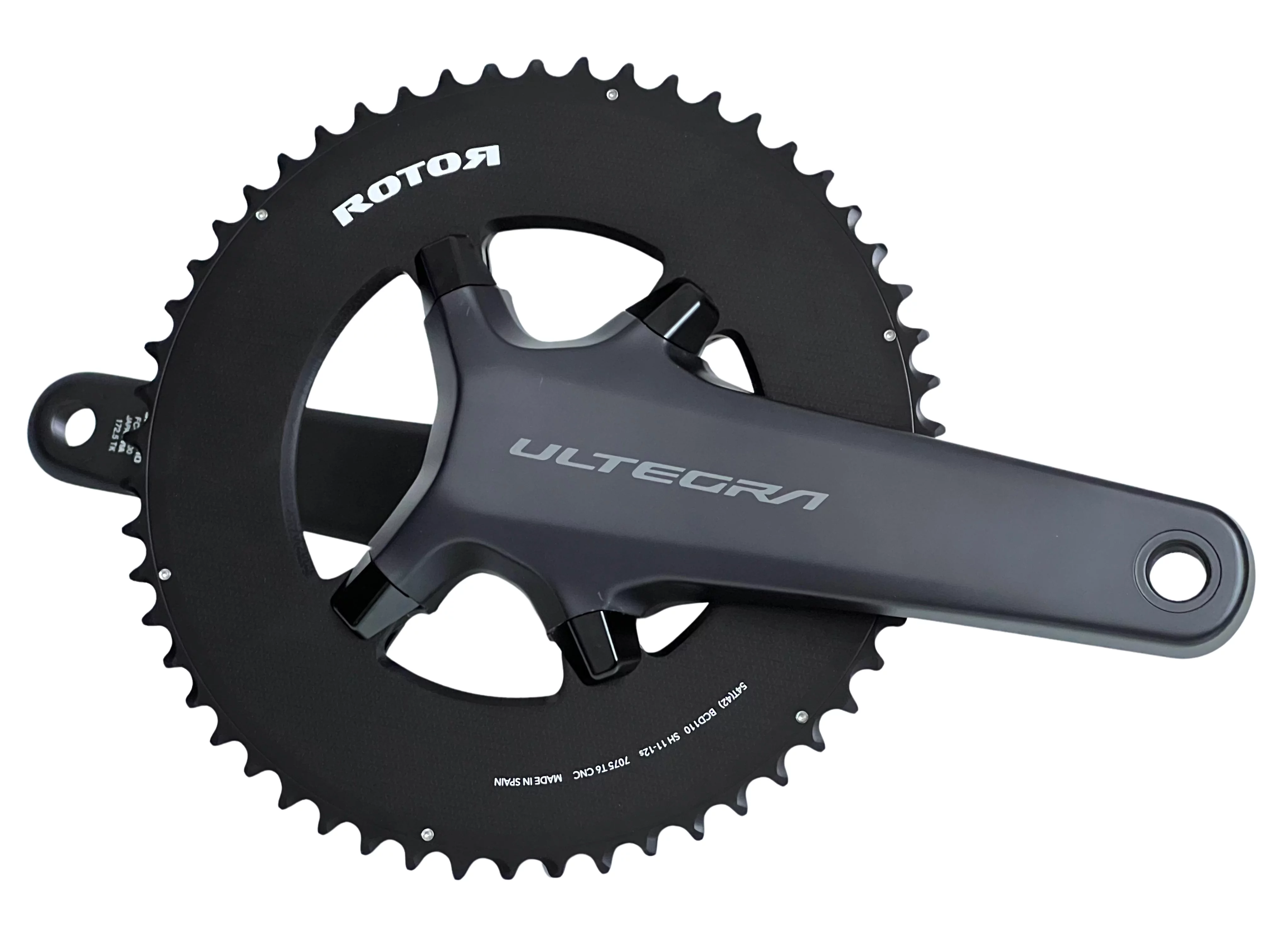
54/39: lighter & more versatile
- Weight: the 39T is often standard (with cut-outs) → a few grams saved vs 42T aero.
- Shorter low gear for the same cassette (e.g., 39×34 = 2.41 m).
- Use case: rolling routes, frequent climbs, long endurance rides.
Q-Rings standard version
54/42: speed & inertia
- Aero & stiffness: the 42T is often full/aero, very stable at high speed.
- 12T jump (54→42): crisp shifts to keep cadence sweet spots at >45 km/h.
- Use case: triathlon, TT, fast pacelines, aero bikes.
Q-Rings aero version
With a 11–34 cassette (Shimano 12s), you get 42×34 ≈ 2.60 m — a genuinely low gear, fine for trained riders. On older cassettes ending at 28, 42×28 ≈ 3.16 m — much tougher on steep grades.
Gear development table (m / pedal rev)
Calculated with a 2105 mm wheel circumference (700×25C). Adjust for your tyres.
| Sprocket | 54/39 setup | 54/42 setup | ||
|---|---|---|---|---|
| Big ring | Small ring | Big ring | Small ring | |
| 11 | 54×11 — 10.33 | 39×11 — 7.46 | 54×11 — 10.33 | 42×11 — 8.04 |
| 12 | 54×12 — 9.47 | 39×12 — 6.84 | 54×12 — 9.47 | 42×12 — 7.37 |
| 13 | 54×13 — 8.74 | 39×13 — 6.31 | 54×13 — 8.74 | 42×13 — 6.80 |
| 14 | 54×14 — 8.12 | 39×14 — 5.86 | 54×14 — 8.12 | 42×14 — 6.31 |
| 15 | 54×15 — 7.58 | 39×15 — 5.47 | 54×15 — 7.58 | 42×15 — 5.89 |
| 17 | 54×17 — 6.69 | 39×17 — 4.83 | 54×17 — 6.69 | 42×17 — 5.20 |
| 19 | 54×19 — 5.98 | 39×19 — 4.32 | 54×19 — 5.98 | 42×19 — 4.65 |
| 21 | 54×21 — 5.41 | 39×21 — 3.91 | 54×21 — 5.41 | 42×21 — 4.21 |
| 24 | 54×24 — 4.74 | 39×24 — 3.42 | 54×24 — 4.74 | 42×24 — 3.68 |
| 28 | 54×28 — 4.06 | 39×28 — 2.93 | 54×28 — 4.06 | 42×28 — 3.16 |
| 30 | 54×30 — 3.79 | 39×30 — 2.74 | 54×30 — 3.79 | 42×30 — 2.95 |
| 34 | 54×34 — 3.34 | 39×34 — 2.41 | 54×34 — 3.34 | 42×34 — 2.60 |
Tip: speed (km/h) ≈ cadence × development × 60 / 1000. Example: 54×11 at 95 rpm ≈ 58.9 km/h.
Compatibility & setup (Rotor)
- Pick the matched version (54/39 or 54/42) for optimal front shifting.
- Check front derailleur height & alignment after moving to a 54T big ring.
- For Rotor 30 mm cranks, pair with a quality bottom bracket (BSA / BB86 / T47) to minimise drivetrain losses.
For fast riding (tri/TT/pacelines), 54/42 is formidable: cadence stability and aero gains. If you want true versatility (mixed terrain, regular climbs, endurance), 54/39 is the safe bet — especially if your cassette doesn’t go to 34.
FAQ
Does Ultegra 12-speed offer 54/40?
Can I climb with a 54/42 crankset?
Which is more versatile: 54/39 or 54/42?
Which Rotor kits do you recommend for Shimano 12-speed?
Any setup tips when moving to a 54T big ring?
Why switch to a complete ROTOR ALDHU crankset?
Need a tailored recommendation (terrain, goals, FTP, cadence)? Velo-Perso express contact.