52/36 crankset: the sweet spot for versatile riders
Why choose a 52/36?
The 52/36—often called “semi-compact”—suits riders who want climbable gears in the hills while keeping a true cruising speed on the flat. It strikes a balance between a compact 50/34 and a racier 53/39.
At a glance:
- 52T lets you hold speed on flats and gentle descents without overspinning.
- 36T will get you up most climbs, ideally paired with an 11–32 or 11–34 cassette.
Common assumption: 700×25C wheel (circumference 2.105 m).
Gear comparison (11–34 cassette)
| Tooth pairing | Top rollout (with 11T) |
Lowest gear (with 34T) |
Recommended use |
|---|---|---|---|
| 50/34 | 9.57 m | 2.10 m | Mountains, endurance |
| 52/36 | 9.95 m | 2.23 m | All-round, gran fondo |
| 53/39 | 10.14 m | 2.41 m | Racing, high speed |
Figures computed with a 2.105 m wheel circumference (700×25C). Consistent with the detailed 52/36 × 11–34 table below.
Detailed table — Rollout (m) & speed at 90 rpm (52/36 × 11–34)
Speed (km/h) at 90 rpm = rollout × 5.4.
| Sprocket | 52 T (m) | 36 T (m) | Speed 90 rpm (52T) | Speed 90 rpm (36T) |
|---|---|---|---|---|
| 11 | 9.95 | 6.89 | 53.7 | 37.2 |
| 12 | 9.12 | 6.31 | 49.3 | 34.1 |
| 13 | 8.42 | 5.83 | 45.5 | 31.5 |
| 14 | 7.82 | 5.41 | 42.2 | 29.2 |
| 15 | 7.30 | 5.05 | 39.4 | 27.3 |
| 17 | 6.44 | 4.46 | 34.8 | 24.1 |
| 19 | 5.76 | 3.99 | 31.1 | 21.6 |
| 21 | 5.21 | 3.61 | 28.1 | 19.5 |
| 24 | 4.56 | 3.16 | 24.6 | 17.1 |
| 27 | 4.05 | 2.81 | 21.9 | 15.2 |
| 30 | 3.65 | 2.53 | 19.7 | 13.6 |
| 34 | 3.22 | 2.23 | 17.4 | 12.0 |
Color is mapped to rollout (m/rev) and shared across all cells (not per sprocket).
Reading tip: when the 52T column shifts to yellow/green (27→34T), the adjacent 36T gives similar gear inches at a higher cadence.
Can I switch my Shimano to 52/36?
Yes. If you ride Shimano Ultegra or Dura-Ace 12-speed you can:
- Swap the chainrings for a 52/36 pair compatible with your crank.
- Choose Rotor rings (Shimano 12-sp compatible) for extra stiffness and power transfer.
Velo-Perso tip: 52/36 + power meter
Pairing 52/36 with a power meter helps you manage effort and nail tempo/sweet-spot work for gran fondos.
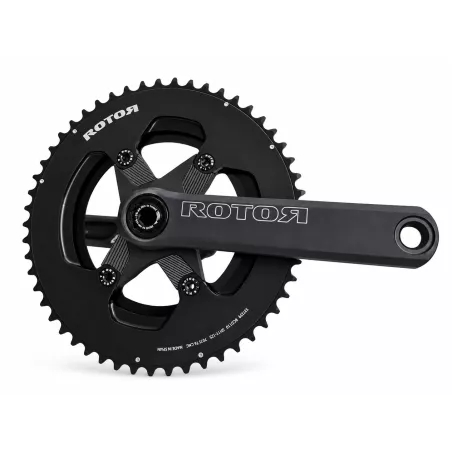
- Rotor crank in 52/36 with Inspider 2.0.
- Aldhu or Aldhu Carbon arms per weight/stiffness/budget.
- High-quality ceramic bottom bracket for smooth, durable drive.
Our 52/36 picks
Complete Rotor cranksets (52/36)
- Rotor Aldhu 52/36 — arms 170 / 172.5 / 175 mm.
- Rotor Aldhu Carbon 52/36 — premium builds (30 mm axle).
- Rotor Vegast 52/36 — great weight/price ratio (24 mm or 30 mm axles).
Power meters
- Inspider 2.0 with Aldhu arms — modularity, accuracy, low weight.
- Left-only options to start on a budget.
- Dual-sided options — compatible with Garmin / Wahoo / Zwift.
52/36 chainrings compatible with Shimano
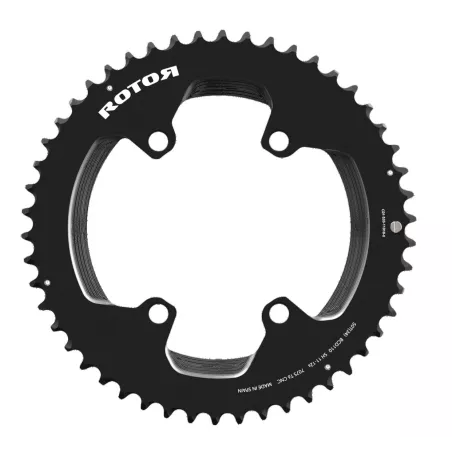
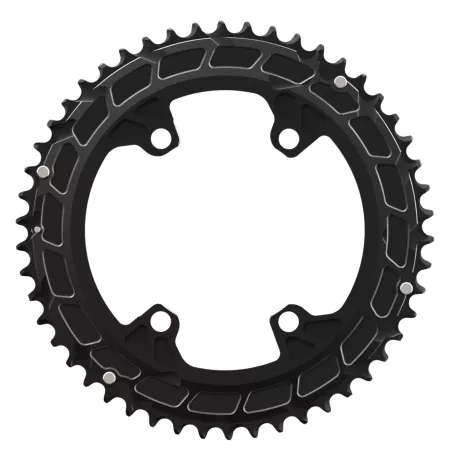
- Rotor 52/36 chainrings for Shimano 12-speed cranks.
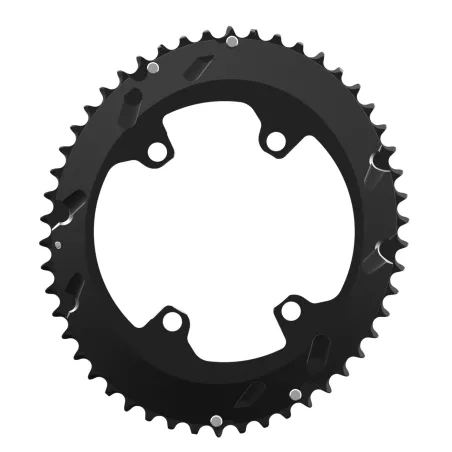
- Available in round or oval (Q-Rings).
- Ideal for Ultegra R8100 / Dura-Ace R9200.
Velo-Perso.com has advised riders since 2009: real-world testing, tailored builds, and fast technical support (WhatsApp, Instagram, or our contact form).
Our standard 52/36 cranks below:
Our 52/36 Powermeters below:
Our 52/36 chainrings to adapt to an existing crankset
FAQ – 52/36 Cranksets
Who is the 52/36 crankset for?
The 52/36 suits versatile cyclists—competitive riders or well-trained amateurs. It’s ideal if 50/34 feels too small on flat roads but you’re not ready for the demands of 53/39.
Can I upgrade from 50/34 to 52/36 without changing the whole crankset?
Yes. With Shimano Ultegra or 105 (12-speed), you can replace only the chainrings with a Rotor 52/36 pair—an affordable, quick upgrade.
What are the benefits of Rotor 52/36 chainrings vs Shimano?
- Higher stiffness for cleaner power transfer.
- Precise shifting thanks to CNC machining.
- Refined, near-aero machining even though Rotor no longer offers a dedicated 52/36 “aero” model.
Is 52/36 compatible with all front derailleurs?
Generally yes. As a mid-range configuration, 52/36 typically falls within the intended adjustment range of modern front derailleurs.
Do I need a different chain when switching from 50/34 to 52/36?
You may need to add 1–2 links if your chain was cut very short. Always verify length using the big chainring / big cog method (bypass the derailleur), then add two links.
Is cross-chaining with 52/36 acceptable?
Yes—on flat terrain, staying in the 52T with larger cogs is often more efficient than dropping to the small ring with a large cog. This aligns with modern drivetrain recommendations.
Can I climb steep hills with a 52/36?
Absolutely. With a 36T inner ring and an 11–36 cassette, you achieve a 1:1 ratio—great for tough gradients even with modest fitness.
Can I race at over 40 km/h with a 52/36?
Yes. For most amateur races at ~40–43 km/h, 52/36 works well. Above ~45 km/h (elite level), a 53/39 may be preferable. Powerful riders can still sprint past 60 km/h on 52T with suitable final gearing.
Oval or round 52/36?
Rotor Q-Rings (oval) can help through the dead spot and improve perceived torque—useful if you’re not ready for 53/39. Treat them as a training complement, not a substitute for fitness.
Can I go back to 50/34 after an injury or break?
Yes. Switching back to 50/34 is sensible during recovery or easy blocks. Re-check chain length and front-derailleur limits afterward.
Can I install a 52/36 on a SRAM AXS groupset?
Standard SRAM AXS uses 48/35 and 50/37 (10T start cassette gives similar overall gearing to 52/36). Since 2024, SRAM offers 52/39 on Red—verify front-derailleur compatibility and follow SRAM’s setup guidelines. For a strict 52/36 setup in 2025, a Shimano-based solution is usually simpler.

Olivier from velo-perso.com
Back in my Elite N1 racing days in the 2000s, I already had an unconventional approach to gear: while 53t rings were the norm, I regularly raced on 55t, or even 56t for Time Trials. This obsession with the "perfect ratio" has been refined since 2009 through constant feedback from my clients and power meter analysis. Today, I ride a 53/39 for its ultimate versatility. This guide is built on that dual perspective: the demanding racer and the technician seeking the ideal setup for every rider.
"Take it step by step, but stay ambitious!"