Oval chainrings: are they still worth using in 2025?
Oval chainrings had their golden age in the early 2010s. Chris Froome in the mountains, Thomas De Gendt in long breakaways, Pierre Rolland in some seasons: for a few years it looked as if every climber in the pro peloton was using oval rings.
At Velo-Perso.com we arrived on the market in 2009 as a Rotor dealer, right when the brand was booming. A large share of our crankset sales at the time were Rotor Q-Rings. Since then round rings have come back strongly, but we still have a core of loyal customers who would never switch back to round.
1. A simple reminder: power, torque and cadence
To understand the potential interest of an oval chainring, we need to start from the basics: the power you produce on the bike is the combination of cadence (pedalling speed, in revolutions per minute) and torque (in Newton metres, Nm).
Power = Torque × Cadence
- You can spin at 120 rpm, but in a road race your heart rate will explode sooner or later.
- You can push 100 Nm of torque, but the stress in your legs is huge.
The sweet spot is neither all-out high cadence nor brute-force low cadence: you want reasonable torque at a comfortable cadence, with the smoothest possible power delivery over the full 360°.
When cyclists talk about “pedalling in circles”, that’s exactly what they mean: avoiding big dead spots and violent torque spikes on each revolution. That’s where oval chainrings promise to help.
2. So what exactly is an oval chainring?
A classic round chainring has the same diameter all along the rotation. An oval ring has a diameter that varies with crank angle. The idea is straightforward:
- Smaller effective diameter around the dead spot (cranks vertical).
- Larger effective diameter where you can produce the most torque (cranks roughly horizontal).
Imagine an oval Rotor chainring with 53 teeth:
- around the dead spot it behaves roughly like a 50 T, easier to push,
- near the power phase it feels closer to a 56 T.
The oval ring does not magically create watts, but it shifts the effort towards the angles where you are naturally strongest, and eases the weaker zones.
3. OCA & OCP: two angles that matter
Rotor’s oval rings are built around two key concepts:
- OCA (Optimal Chainring Angle): the angle where you produce the highest average torque over one revolution.
- OCP (Optimal Chainring Position): the mounting position of the oval ring that aligns its long axis with this torque peak.
With a Rotor power meter (Inpower, Inspider…), the app analyses your pedal stroke over 360°, several times per second. It displays the torque curve, computes your OCA and recommends an OCP position so that the oval ring is correctly oriented relative to your pedalling style.

4. Three pedal strokes analysed: 67, 95 and 107 rpm
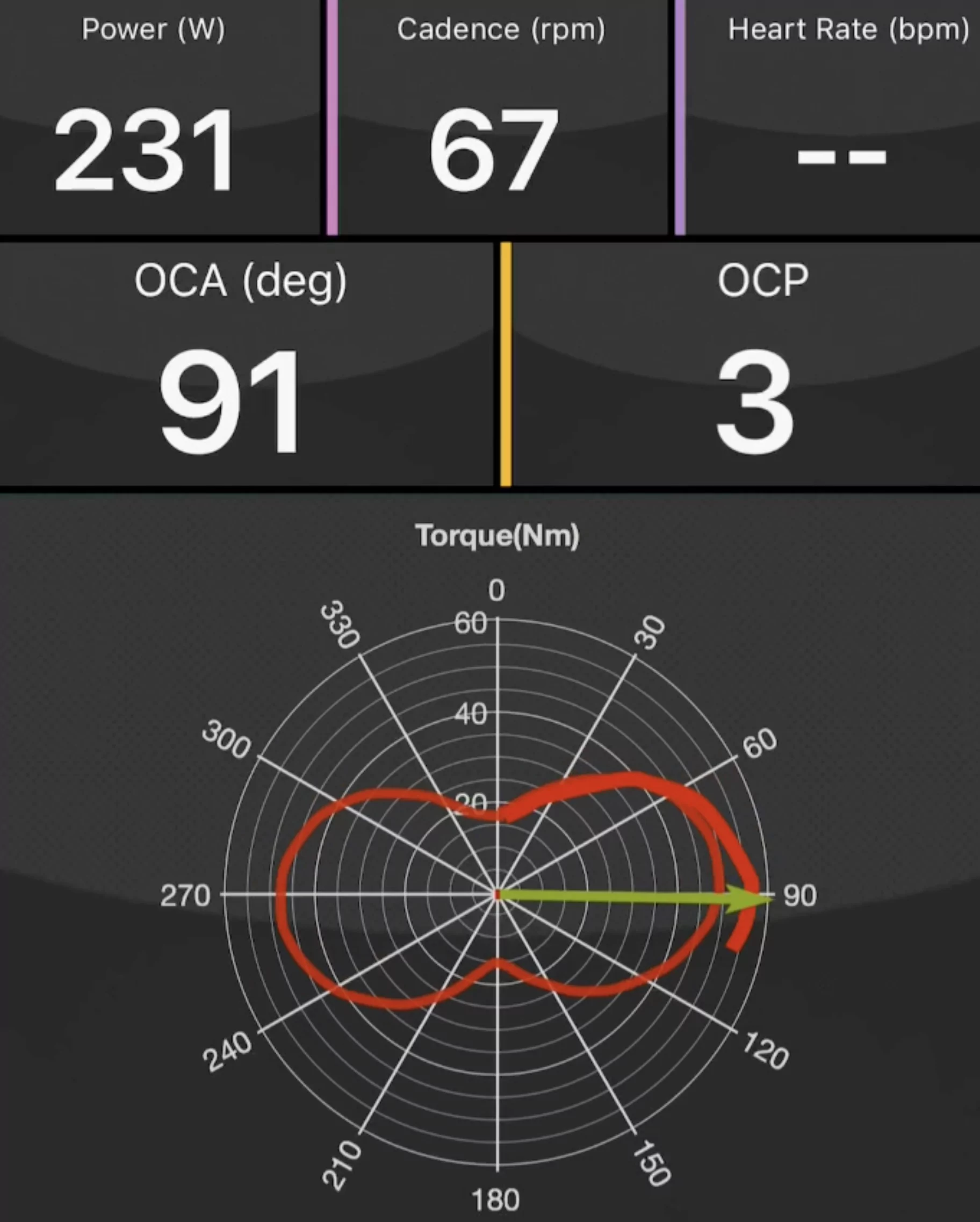
To show what really happens, we recorded the same rider on a trainer at three different cadences, using a Rotor power meter. On each screenshot you see:
- power and cadence,
- OCA (optimal torque angle),
- suggested OCP,
- and the 360° torque curve (in red).


| Situation | Power | Cadence | OCA | OCP | What we see |
|---|---|---|---|---|---|
| 1. “Tempo” cadence | 223 W | 95 rpm | 97° | 4 | Torque between ~25 and 35 Nm: overall smooth, dead spot still visible. |
| 2. Low cadence | 231 W | 67 rpm | 91° | 3 | Torque jumps from ~17 Nm to nearly 50 Nm depending on angle: very jerky stroke. |
| 3. High cadence | 258 W | 107 rpm | 101° | 5 | Torque close to 25 Nm all around: “dream” stroke, perfect to save your legs, but hard to maintain for long. |
Looking at these graphs, two things become obvious:
- the closer the curve is to a circle, the smoother and more comfortable the pedalling;
- OCA – and therefore the optimal OCP – shifts with cadence.
5. The real benefits of oval chainrings
If we put the marketing aside, oval rings mainly bring gains in load distribution and medium/long-term comfort.
What an oval ring really does for you
- Reduces the dead spot: the ring “shrinks” in the weak zone.
- Limits torque spikes: torque is spread more evenly over the revolution.
- Encourages a slightly higher cadence: many riders gain a few rpm on average.
- Reduces muscular stress: fewer “hammer blows” in the legs each turn.
- Helps sensitive knees: fewer peak loads on the joint.
- Shines in steady efforts: mountains, triathlon, long solo tempo rides.
6. The dead-spot dilemma: where the limits start
Back to the problem mentioned earlier: your OCA moves with cadence. The Rotor app might easily suggest:
- OCP 3 at low cadence,
- OCP 4 for your usual cruising cadence,
- OCP 5 for very high cadence work.
But your chainring is mounted in one fixed position. You can’t switch from OCP 3 on a long climb to OCP 5 for the finishing sprint just by turning a dial.
In practice this means:
- you will be perfectly set up in some situations (for example a long, regular ascent),
- and slightly “out of sync” in others (attacks, sprints, big cadence changes).
To change OCP you must remove the crank and rotate the spider or Spidering on the axle. It’s a workshop job, not a mid-race tweak.
7. Who can benefit from oval chainrings?
Riders who often benefit
- Solo riders: long outings at a steady pace.
- Climbers: on regular climbs the dead spot moves very little, oval rings work well.
- Riders with knee issues: fewer torque peaks, less joint stress.
- Triathletes: steady power in the 200–300 W range, very linear pacing.
- Gravel / MTB riders: to get over short, very steep ramps when you’re “two teeth short”.
Riders for whom ovals are often pointless (or annoying)
- Sprinters: at very high cadence, torque is already extremely constant; ovals add nothing.
- Criterium / punchy racers: constant accelerations, cadence changing all the time.
- Young, very fast-spinning riders aiming at pro level: with modern 12-speed cassettes they can do almost everything on round rings.
- Beginners: better to first stabilise a good pedal stroke on round rings.
8. Impact of 12-speed drivetrains and shorter cranks
Modern equipment has changed the picture and reduced the need for oval rings in many cases.
- 12-speed brought finer cassette steps and a wider range. You almost always find a sprocket that lets you stay in cadence instead of grinding a huge gear.
- Shorter crankarms have become very common (165 mm, 160 mm, even 155 mm). Every millimetre you remove tends to raise natural cadence a little. From our experience, 1 mm shorter roughly equals +1 rpm on average.
Combining 12-speed + short cranks already helps many riders pedal smoother and faster, with less muscular fatigue – even on round chainrings.
9. An underrated combo: shorter cranks + oval chainring
When you shorten crankarms you gain cadence but lose mechanical leverage and a bit of torque. One way to compensate for that loss is to use an oval ring.
This approach has worked very well for some of our customers: they increased their cadence, reduced leg pain and felt more comfortable on the steepest ramps.
10. Do oval chainrings really increase power?
This is the question that always comes up. Rotor has long communicated on potential power gains, and that’s not entirely wrong – but it’s not a universal truth either.
What we see in the real world
- In very short MAP / VO2max tests, the limiting factor can be leg pain rather than heart rate. In that case an oval ring can sometimes help you hold target power a few seconds longer.
- In real racing it’s different: phases where the oval is perfectly aligned alternate with others where it’s not, so gains in one place can be partly cancelled elsewhere.
At Velo-Perso we therefore prefer to present oval rings as a tool to smooth out effort, improve comfort and regularity rather than a magic “extra watts” button.
11. Why are oval chainrings still relatively rare?
To work really well, oval chainrings require a personalised setup: OCP, crank length, terrain, rider profile. It’s not the kind of product you can mount randomly on a stock bike and expect everyone to love it.
A mass player like Shimano has little interest in releasing a very niche product if half of users end up poorly adjusted and disappointed. Rotor chose another route: highly refined technology that needs a bit of support to show its full potential.
12. How “oval” are Rotor chainrings?
Rotor has evolved quite a bit over the years:
- early Q-Rings had about 10 % ovality;
- QXL went up to 15 % for a more pronounced effect;
- most of the current range sits at 12.5 %, a compromise we find very sensible for road and gravel use.
Combined with a Rotor power meter (Inpower, Inspider 2.0…) and the analysis software, these rings let you measure your OCA precisely and fine-tune OCP to get the best out of your pedalling.
13. So… should you run an oval chainring on your bike?
To sum it up in simple terms:
- Yes if you ride a lot at steady pace, enjoy climbing, already have a decent pedal stroke and are looking for more comfort and smoothness.
- Rather no if your rides or races are very punchy, with constant changes of rhythm.
- No if you are a pure sprinter or a complete beginner on the road bike.
Modern equipment (12-speed drivetrains, shorter cranks, 11-34 cassettes) already helps many riders pedal more smoothly. Oval rings are no longer a necessity, but they remain a very interesting option for certain profiles – especially climbers, strong solo riders and triathletes.
Velo-Perso’s opinion
At Velo-Perso.com we’ve been testing Rotor chainrings and power meters since 2009, both in the mountains and on the flat. Our job is not to tell you “oval is always better”, but to look at your riding style, your current gearing and your goals, then guide you towards the most coherent option: a lighter round crankset, shorter cranks, a properly set up oval ring, or a smart combination of these.
Feel free to contact us in English or French via WhatsApp, social networks, or the contact form on each product page. We can analyse your Rotor data (OCA/OCP) or simply start from your sensations to help you make the right choice.